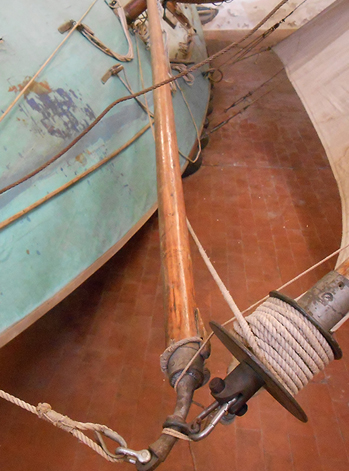
The most beautiful boat that has ever sailed the waters of Lake Como—when we talk about the Cisko, it’s like talking about Stradivari. Those are boats made by artists.
Such is the fame of the Cisko-Yu, according to the accounts of those who saw it race. And besides being beautiful, it was also unbeatable.
Legend has it that the fear of competing against the Cisko-Yu was so great that no one showed up for the regattas.
Its history dates back to the early 1800s, when the British began importing their prestigious boats to the lake, which immediately captivated people not only with their remarkable elegance but also with their extraordinary speed. It was then that a veritable race began among Italian sailing enthusiasts to acquire a British boat.
Emilio Cramer did just that; in 1896, he commissioned the TAGG&SON shipyard in Hampton Court on the Thames to build a racer.
The design was entrusted to LINTON HOPE, one of the finest naval architects of the time. Hope built a boat with extraordinary performance, featuring a wide, thin hull made of Slavonian oak, called a “skimming disk”—a flat surface that glides over the water.
Cramer named this boat YU, in honor of his beautiful Indian fiancée. Only two boats similar to the YU were built. One belonged to the Duke of Aosta, and a third belonged to the Brambilla family; that one is also on display in this room. The Spindirf.
The YU was later purchased by the Carcano family, and its name was officially changed to Cisko in honor of his father, Francesco.
Under Carcano’s ownership, the Cisko racked up victory after victory. He also won the Villa d’Este Gold Cup for three consecutive years. One of the noteworthy technical innovations is the sail’s design, which was truly futuristic for its time.
The sail is reinforced with three internal battens and raised stitching to improve its aerodynamics. Another innovation was the introduction of the Portuguese Pennola, an antenna peak so steeply angled that it almost aligned with the mast, resulting in a mainsail that was nearly triangular in shape.
The mast was constructed from Indian bamboo, the lightest and strongest material known at the time.
The most beautiful boat that has ever sailed the waters of Lake Como—when we talk about the Cisko, it’s like talking about Stradivari. Those are boats made by artists.
Such is the fame of the Cisko-Yu, according to the accounts of those who saw it race. And besides being beautiful, it was also unbeatable.
Legend has it that the fear of competing against the Cisko-Yu was so great that no one showed up for the regattas.
Its history dates back to the early 1800s, when the British began importing their prestigious boats to the lake, which immediately captivated people not only with their remarkable elegance but also with their extraordinary speed. It was then that a veritable race began among Italian sailing enthusiasts to acquire a British boat.
Emilio Cramer did just that; in 1896, he commissioned the TAGG&SON shipyard in Hampton Court on the Thames to build a racer.
The design was entrusted to LINTON HOPE, one of the finest naval architects of the time. Hope built a boat with extraordinary performance, featuring a wide, thin hull made of Slavonian oak, called a “skimming disk”—a flat surface that glides over the water.
Cramer named this boat YU, in honor of his beautiful Indian fiancée. Only two boats similar to the YU were built. One belonged to the Duke of Aosta, and a third belonged to the Brambilla family; that one is also on display in this room. The Spindirf.
The YU was later purchased by the Carcano family, and its name was officially changed to Cisko in honor of his father, Francesco.
Under Carcano’s ownership, the Cisko racked up victory after victory. He also won the Villa d’Este Gold Cup for three consecutive years. One of the noteworthy technical innovations is the sail’s design, which was truly futuristic for its time.
The sail is reinforced with three internal battens and raised stitching to improve its aerodynamics. Another innovation was the introduction of the Portuguese Pennola, an antenna peak so steeply angled that it almost aligned with the mast, resulting in a mainsail that was nearly triangular in shape.
The mast was constructed from Indian bamboo, the lightest and strongest material known at the time.