This is how Pia Sala, daughter of Giacomo—who sailed this marvelous gondola up and down the Como branch in ceaseless commercial service—tells the story.
This is the authentic Gondola Lariana, the most common cargo boat of the region; it could reach up to 28 meters in length and carry up to 100 metric tons.
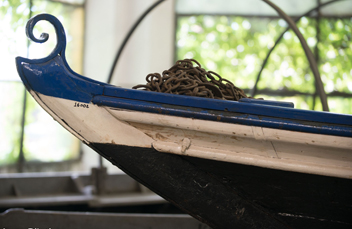
It is characterized by rounded, deeply flared sides, a slender, well-proportioned bow, and a rounded stern. It was used to supply the markets and towns along Lake Como on a daily basis: they transported all kinds of foodstuffs—flour, wine, oil, and even livestock feed.
Its distinctive feature is the numerous hoops, which, joined by a central crossbar, supported the awning, designed to protect the boatman and the cargo from rain and spray. They were usually equipped with two very long oars, called puntàl, which were used to maneuver the boat as it entered and left ports.
You can see some original puntàl hanging from the ceiling of this room. They would anchor at the bottom of the lake and propel the boat with their arms. Once out of the harbor, they would head out to catch the wind.
The rectangular sail, known as a “Roman sail” and typical of boats from Lake Como, was hoisted on a mast positioned right in front of the oars. As tall as the boat was long and as wide as the boat itself, it was remarkably efficient because it relied solely on tailwinds.
With the gondola, one could dock directly at the shore by using the momentum of the bow, which was reinforced for this purpose with a counter-beam called a dulfèn: it acted as a skid to glide along the dock. Once the dulfèn had been eaten, it could easily be replaced.
A long wooden plank, called a pànca, was used for loading and unloading.
This gondola, known as a moltrasina, is considered small in size and was the subject of an academic study by the Milan Polytechnic’s architectural restoration program during the 1988–1989 academic year.
With a hull made of chestnut and larch and a sturdy oak rudder, it was commissioned by a merchant in the early 1900s, who used it to transport wine and provisions between Como and Moltrasio.
This is how Pia Sala, daughter of Giacomo—who sailed this marvelous gondola up and down the Como branch in ceaseless commercial service—tells the story.
This is the authentic Gondola Lariana, the most common cargo boat of the region; it could reach up to 28 meters in length and carry up to 100 metric tons.
It is characterized by rounded, deeply flared sides, a slender, well-proportioned bow, and a rounded stern. It was used to supply the markets and towns along Lake Como on a daily basis: they transported all kinds of foodstuffs—flour, wine, oil, and even livestock feed.
Its distinctive feature is the numerous hoops, which, joined by a central crossbar, supported the awning, designed to protect the boatman and the cargo from rain and spray. They were usually equipped with two very long oars, called puntàl, which were used to maneuver the boat as it entered and left ports.
You can see some original puntàl hanging from the ceiling of this room. They would anchor at the bottom of the lake and propel the boat with their arms. Once out of the harbor, they would head out to catch the wind.
The rectangular sail, known as a “Roman sail” and typical of boats from Lake Como, was hoisted on a mast positioned right in front of the oars. As tall as the boat was long and as wide as the boat itself, it was remarkably efficient because it relied solely on tailwinds.
With the gondola, one could dock directly at the shore by using the momentum of the bow, which was reinforced for this purpose with a counter-beam called a dulfèn: it acted as a skid to glide along the dock. Once the dulfèn had been eaten, it could easily be replaced.
A long wooden plank, called a pànca, was used for loading and unloading.
This gondola, known as a moltrasina, is considered small in size and was the subject of an academic study by the Milan Polytechnic’s architectural restoration program during the 1988–1989 academic year.
With a hull made of chestnut and larch and a sturdy oak rudder, it was commissioned by a merchant in the early 1900s, who used it to transport wine and provisions between Como and Moltrasio.