Lariana Boat Museum

/
/
Venetian Gondola

Venetian Gondola

Venetian Gondola

An ancient and mysterious Venetian gondola bearing the Visconti coat of arms, discovered at Villa Balbianello.

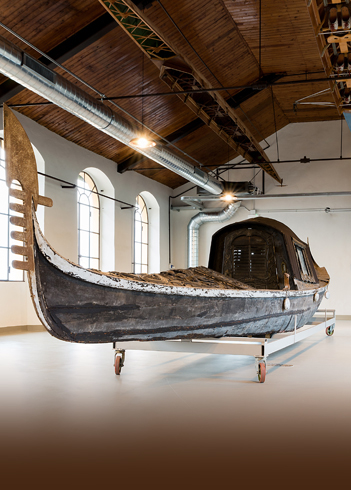
Among the jewels of the MBL collection is this Venetian gondola, the oldest gondola in the world with “felze” and in perfect condition.
The origin of the name “gondola” is a mystery. Devoto-Oli attributes it to a combination of the ancient Greek term kondura (a type of boat) and the Italian d-ondola-re. Another theory suggests that the word originates from “cimbala” or “cimba,” which in medieval times, in certain eastern regions of the Mediterranean, meant “boat.”
The first Venetian gondolas date back to the late 15th and early 16th centuries, but it wasn’t until the 18th century that the gondola took on a more structured form, similar to the one we know today. For centuries, it has been a true status symbol throughout Europe. Apparently, there were Venetian gondolas in St. Petersburg as well.
This example is preserved at the Museo Barca Lariana is of extraordinary importance: not only is it one of the oldest surviving gondolas, but it is also the best-preserved in its original state.


A Venetian gondola built on Lake Como?

Toward the end of the 18th century, some Venetian shipwrights moved to Lake Como to meet the demand for gondolas from the local aristocracy. Among these small shipbuilders were the Taroni family, who later opened one of the most productive and renowned shipyards of the era in Carate Urio.
The Visconti coat of armsis clearly visible on the foredeck—a symbol inextricably linked to Milan and its history: we find it on the shield of Milan City Hall, as well as in the logo of the historic automobile manufacturer Alfa Romeo
The entire history of this precious gondola is recounted in the Multipurpose Hall of our museum.

Venetian Gondola

An ancient and mysterious Venetian gondola bearing the Visconti coat of arms, discovered at Villa Balbianello.

Among the jewels of the MBL collection is this Venetian gondola, the oldest gondola in the world with “felze” and in perfect condition.
The origin of the name “gondola” is a mystery. Devoto-Oli attributes it to a combination of the ancient Greek term kondura (a type of boat) and the Italian d-ondola-re. Another theory suggests that the word originates from “cimbala” or “cimba,” which in medieval times, in certain eastern regions of the Mediterranean, meant “boat.”
The first Venetian gondolas date back to the late 15th and early 16th centuries, but it wasn’t until the 18th century that the gondola took on a more structured form, similar to the one we know today. For centuries, it has been a true status symbol throughout Europe. Apparently, there were Venetian gondolas in St. Petersburg as well.
This example is preserved at the Museo Barca Lariana is of extraordinary importance: not only is it one of the oldest surviving gondolas, but it is also the best-preserved in its original state.


A Venetian gondola built on Lake Como?

Toward the end of the 18th century, some Venetian shipwrights moved to Lake Como to meet the demand for gondolas from the local aristocracy. Among these small shipbuilders were the Taroni family, who later opened one of the most productive and renowned shipyards of the era in Carate Urio.
The Visconti coat of armsis clearly visible on the foredeck—a symbol inextricably linked to Milan and its history: we find it on the shield of Milan City Hall, as well as in the logo of the historic automobile manufacturer Alfa Romeo
The entire history of this precious gondola is recounted in the Multipurpose Hall of our museum.